This guide covers everything you need before placing your first wholesale silver order:
It is the process by which retailers, boutique owners, e-commerce brands, and private-label businesses purchase 925 silver jewelry in bulk directly from manufacturers or authorised distributors at prices that allow profitable resale. Unlike buying from a local jewellery wholesaler or dropship supplier, sourcing directly from a manufacturer gives you control over design, quality, pricing and branding. It also gives you access to the world's most skilled silver craftspeople — many of whom are based in Thailand, a country with centuries of silver jewellery heritage. For brands planning to build a long-term supplier relationship, understanding the wholesale sterling silver sourcing tips principles is essential before placing your first order.
This guide is written specifically for buyers who want to source responsibly and build a long-term supply relationship, not just place a one-off order.
Why Thailand Is the World's Premier Source for 925 Sterling Silver Bangkok has established itself as a global hub for sterling silver jewelry manufacturing. The reasons are structural, not accidental: Skilled artisan workforce: Thailand has a multi-generational tradition of silver craftsmanship, particularly among hill tribes in the north.
925 purity compliance: Thai manufacturers routinely produce to internationally recognised 925 hallmark standards.
Competitive pricing: Lower labour costs without sacrificing quality means better margins for wholesale buyers engaged in 925 silver jewelry wholesale importing. OEM and ODM capability: Most Thai factories accept custom designs, private labelling and bespoke collections.
Export infrastructure: Bangkok's gem and jewellery export ecosystem is mature, with established freight and customs processes.
Glorietta Jewels has been manufacturing 925 sterling silver for established retailers and brands worldwide for over a decade — from our production facility in Thailand. Every piece is hallmarked, quality-tested, and shipped ready for retail.
Before you source, you need to understand exactly what you are buying. ' 925 sterling silver' refers to an alloy that is 92.5% pure silver and 7.5% other metals — most commonly copper. The copper addition improves the durability of the metal without significantly affecting its appearance or value.
For anyone learning how to source wholesale sterling silver jewelry, understanding purity levels is the first step in avoiding quality issues and supplier misrepresentation.
| Silver Type | Silver Content | Typical Use | Durability |
|---|---|---|---|
| 999 Fine Silver | 99.9% | Bullion, coins | Soft — not ideal for jewellery |
| 925 Sterling Silver | 92.5% | Jewellery — rings, chains, earrings | Excellent |
| 900 Silver (Coin Silver) | 90.0% | Antique pieces, US coinage | Good |
| 800 Silver | 80.0% | European cutlery, older pieces | Hard but lower value |
| Argentium Silver | 93.5%+ | Tarnish-resistant jewellery | Excellent |
When sourcing wholesale, you should never accept a supplier's purity claim at face value alone. Here is how professional buyers verify:
Pro Tip: At Glorietta Jewels, every batch is tested for 925 purity before shipment. We provide purity documentation on request — no buyer should have to take quality on faith.
The most common mistake first-time wholesale buyers make is choosing a supplier based on price alone. The supplier relationship in sterling silver is long-term — your brand's reputation is tied to their quality. Here is how to find manufacturers worth trusting.
When learning how to source wholesale sterling silver jewelry, one of the most reliable approaches is to work directly with trusted manufacturer websites like Glorietta Jewels, rather than relying only on third-party platforms.
Established manufacturer websites give you better visibility into product quality, pricing, customization options, and long-term reliability.
Working with trusted manufacturer websites like Glorietta Jewels, a leading silver jewelry manufacturer in Thailand and global exporter, helps you build direct relationships with suppliers, ensuring better communication, superior quality control, and scalable business growth.
Trade shows remain the best way to meet manufacturers face to face, see samples in person, and build relationships that lead to better pricing and priority service. Attending a Thailand silver jewelry exhibition also allows buyers to evaluate product quality, compare multiple suppliers, and establish direct connections with manufacturers.
The most important events for silver jewelry sourcing include major industry gatherings such as the gem and jewellery exhibition in Bangkok, which attracts international buyers and hundreds of manufacturers from across Thailand and Asia.
| Trade Show | Location | When | Best For |
|---|---|---|---|
| Bangkok Gems & Jewellery Fair | Bangkok, Thailand | February & September | Thai silver manufacturers — the single best show for this region |
| Hong Kong International Jewellery Show | Hong Kong | March | Pan-Asian manufacturers; volume buyers |
| JCK Las Vegas | Las Vegas, USA | June | US market connections; global brand discovery |
| INHORGENTA Munich | Munich, Germany | February | European buyers; design-forward collections |
| Vicenzaoro | Vicenza, Italy | January & September | Fine jewellery; Italian craftsmanship focus |
If you know the region you want to source from, direct outreach to manufacturers — by email, phone or in-person visit — often yields better terms than going through a platform. Thai factories are generally open to receiving buyers and providing factory tours.
When making direct contact, prepare a clear brief including:
The most common mistake first-time wholesale buyers make is choosing a supplier based on price alone. The supplier relationship in sterling silver is long-term — your brand's reputation is tied to their quality. Understanding how to verify sterling silver purity and supplier credibility is an important step when evaluating potential manufacturers. Here is how to find manufacturers worth trusting
| Checkpoint | What to Ask / Check | Red Flag |
|---|---|---|
| Business Legitimacy | Request company registration documents. Verify they are a registered entity in their country. | Reluctance to share any legal documentation |
| Factory Ownership | Are they a factory or a trading company? Ask for factory photos and videos. | Only product photos; vague answers about production location |
| 925 Certification | Request purity test reports for previous batches. Ask if they use XRF testing. | Cannot provide any purity documentation |
| Sample Quality | Always order a paid sample run before bulk. Inspect hallmarking, finish, weight, clasp function. | Refuses to provide samples; sample quality inconsistent |
| MOQ Flexibility | Ask for the genuine MOQ per style and per order. Good suppliers are transparent. | Dramatically different MOQ quote on follow-up |
| Lead Time Honesty | Ask for average lead time and what causes delays. Check against customer reviews. | Promises unrealistically fast turnaround |
| Communication | Assess response time and English quality. Poor communication pre-order = disaster post-order. | Days between replies; evasive answers |
| References | Ask for references from existing international buyers. | Refuses or cannot provide any references |
| Payment Terms | Understand T/T, LC, escrow options. Never pay 100% upfront for first order. | Demands full payment upfront with no escrow option |
During this vetting stage, buyers should also learn how to verify sterling silver purity through hallmark inspection, supplier documentation, and independent testing before committing to large production runs.
Factory Visits: Worth the Trip?
For orders above $10,000–$15,000, a factory visit is almost always worth the investment. Visiting in person allows you to:
Bangkok is easily accessible, with direct or one-stop flights from most major cities. The Bangkok Gems & Jewelry Fair (February and September) is an ideal time to combine factory visits with trade show attendance.
Pricing and MOQs are the two questions every wholesale buyer asks first — and the two areas where expectations most commonly misalign with reality. Understanding how MOQ works in wholesale jewelry can help buyers plan their budgets, product mix, and supplier negotiations more effectively. Here is a clear-eyed breakdown.
Unlike fast fashion, sterling silver jewelry pricing is not arbitrary. It is driven by real cost components that you should understand before negotiating:
| Cost Component | What It Covers | Notes for Buyers |
|---|---|---|
| Silver Spot Price | Raw material cost based on live market price of silver (XAG/USD) | Fluctuates daily. Reputable manufacturers price using a benchmark date. |
| Silver Weight | Grams of 925 silver per piece × spot price | Heavier pieces cost more. Always ask for weight per piece. |
| Labour | Casting, polishing, setting, assembly | Thai labour is internationally competitive but should not be near zero. |
| Design / Tooling | Die or mould creation for custom designs | One-off cost, amortised over production runs. Expect $50–$500 per design. |
| Gemstone Setting | Cost of stones + setting labour (if applicable) | Varies hugely. CZ is cheap; genuine stones significantly higher. |
| Plating | Rhodium, gold vermeil or other surface finish | Adds $0.50–$3.00 per piece depending on finish and coverage. |
| Packaging | Polybag, box, anti-tarnish strip, hang tag | Often charged separately. Important for retail-ready presentation. |
| Profit Margin | Factory margin (typically 20–40%) | Legitimate factories need margin — suspiciously low prices often mean quality shortcuts. |
MOQs vary significantly by manufacturer type and product category. For buyers exploring custom production, a clear custom silver jewelry MOQ guide can help set realistic expectations before approaching a supplier. Here is a realistic guide:
| Scenario | Typical MOQ | Notes |
|---|---|---|
| Stock designs (ODM) | 10–50 pieces per style | Lowest barrier — ideal for first-time buyers testing the market |
| Slightly modified stock (ODM) | 50–200 pieces per style | Minor customisation such as logo addition or stone colour change |
| Fully custom design (OEM) | 100–500 pieces per style | Tooling costs apply. Best for established brands placing repeat orders |
| Entire collection (OEM) | 500–2,000 pieces total | Factory typically requires commitment across multiple SKUs |
| Private label packaging only | No change to product MOQ | Just adding your brand to existing designs — lowest risk entry |
Negotiation Tip: Most manufacturers will flex on MOQ for buyers who commit to a longer-term relationship or a larger total order value. If you want 30 pieces of 10 styles, frame the conversation as a 300-piece order rather than ten separate 30-piece requests.
A sample order is your most important due diligence tool. Never skip it, regardless of how professional a manufacturer appears online. For buyers researching how to order jewelry samples from suppliers, understanding the sample process is essential before committing to a bulk purchase. Here is everything you need to know about testing a manufacturer through samples.
When placing a sample order for wholesale silver jewelry, make sure you request the following:
Sample orders are typically charged at cost price or a small premium — usually 1.5–3x the eventual bulk unit price. This covers the manual effort of producing one-off pieces outside a production run. Standard sample lead times from Thai manufacturers are 7–21 days depending on complexity.
| Inspection Area | What to Check |
|---|---|
| Hallmarking | Is '925' stamped clearly and in the correct location? Is the stamp clean and legible? |
| Finish Quality | Is the polish even? Are there scratches, tool marks or pitting? Is oxidation even? |
| Weight | Weigh each piece on a jeweller's scale. Compare to the spec sheet. Under-weight = silver was substituted. |
| Stone Setting | Are stones secure? Any movement or looseness? Correct stone type and colour? |
| Clasps and Findings | Do clasps open and close smoothly? Are jump rings fully closed? |
| Dimensions | Measure against spec sheet. Consistent sizing matters for rings especially. |
| Anti-Tarnish | Is any protective coating applied? Will it survive shipping and retail display? |
| Packaging | Is it retail-ready? Does it protect the piece? Does it reflect your brand expectations? |
Important: If samples have quality issues, do not assume the manufacturer will 'fix it in production'. What you see in a sample — which is typically their best work — is what you should expect at scale, or better. Never compromise on sample quality.
Private labelling is the process of sourcing products from a manufacturer and selling them under your own brand name. It is one of the most powerful ways to build a premium jewelry brand without owning a factory — and Thailand's silver manufacturing ecosystem is ideally set up for it.
For entrepreneurs researching how to build a private label sterling silver brand, Thailand offers strong manufacturing capabilities, skilled artisans, and flexible production models that make launching a jewelry business much easier.
| Model | Definition | Best For | Typical MOQ |
|---|---|---|---|
| ODM (Original Design Manufacturer) | You choose from the manufacturer's existing designs and add your branding | New brands; lower startup cost; faster time to market | 10–50 pieces/style |
| OEM (Original Equipment Manufacturer) | You provide your own designs; manufacturer produces them | Established brands; unique product differentiation | 100–500 pieces/style |
| Hybrid | Start with ODM designs; gradually introduce custom OEM styles as volume grows | Growing brands balancing risk and differentiation | Mixed |
Glorietta Jewels offers a full private-label program — from selecting existing designs to producing custom collections. We handle hallmarking, packaging and retail-ready presentation, so you can focus entirely on selling and growing your brand.
Understanding the import process before you place your first order will save you from expensive surprises. Here is a practical overview of what to expect.
| Method | Transit Time | Best For | Approximate Cost |
|---|---|---|---|
| Air Freight (Express) | 3–7 days | Urgent orders; first samples; low-volume high-value | $$$ — typically $8–$20/kg |
| Air Freight (Standard) | 5–14 days | Regular wholesale orders; balance of speed and cost | $$ — typically $4–$8/kg |
| Sea Freight (FCL) | 20–40 days | Very large volume orders (full container) | $ — lowest cost/kg but high minimum |
| Sea Freight (LCL) | 25–45 days | Medium volume; shared container space | $ — affordable for mid-size wholesale |
| DHL/FedEx/UPS Direct | 3–10 days | Samples, small initial orders | $$$ — expensive per kg but simple |
Import duties on sterling silver jewelry vary significantly by destination country. Always consult a licensed customs broker for your specific situation, but here is a general orientation:
Always work with a freight forwarder who has experience in jewelry imports. They will handle HS code classification, duty calculation, documentation (commercial invoice, packing list, certificate of origin) and customs clearance on your behalf.
Some markets require independent hallmarking or assay office testing before silver jewelry can be sold legally. Key requirements:
The best buyers do not simply purchase inventory — they build partnerships.
Successful 925 silver jewelry wholesale sourcing depends on long-term relationships with trusted manufacturers.
These strategies are among the most important sterling silver jewelry business sourcing tips for scaling a successful jewellery brand.
For stock ODM designs, most Thai manufacturers set MOQs of 10–50 pieces per style. For custom OEM designs requiring tooling, expect 100–500 pieces per style. Total order MOQs (across all styles) typically start at $500–$2,000 for established manufacturers.
Pricing depends on silver weight, labour complexity, and finishing. Simple silver stud earrings may cost $2–$6 per pair wholesale. A complex ring with gemstone setting could be $15–$40. Always request per-piece pricing with a weight specification to compare fairly across suppliers.
Request company registration documents, a factory address, and purity test reports. Place a sample order before committing to bulk. Check for a verifiable online presence, ask for buyer references, and if volume warrants it, visit the factory in person.
Standard production lead times from Thai manufacturers are 3–6 weeks for stock designs and 6–10 weeks for custom OEM designs. Add 3–14 days for shipping depending on freight method. Always build buffer time into your buying calendar.
Yes. Thai manufacturers routinely offer private-label programs. You can add your brand to existing ODM designs (simplest) or produce fully custom OEM collections. Branding can be applied via laser engraving, custom packaging, swing tags, and polishing cloths bearing your logo.
Thailand is one of the world's most respected origins for 925 sterling silver jewelry. Thai manufacturers have deep craft traditions, invest in modern production equipment, and routinely produce to international quality standards. As with any sourcing decision, quality varies by manufacturer — which is why vetting and sampling are essential.
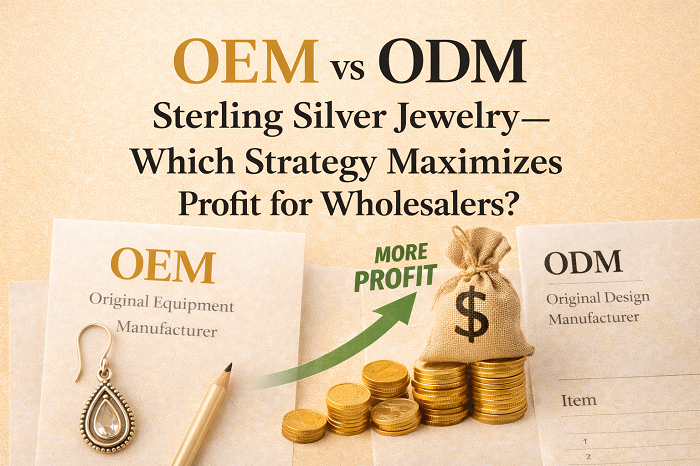
ODM (Original Design Manufacturer) means you choose from the factory's existing design library and apply your branding. OEM (Original Equipment Manufacturer) means you provide your own designs and the factory manufactures them for you. ODM is lower cost and faster; OEM gives you unique, differentiated products.
You will need a freight forwarder experienced in jewelry imports. Key steps include: obtaining a commercial invoice and packing list from your supplier, classifying the goods under the correct HS code (7113.11), paying applicable import duties, and submitting pieces over 7.78g to a UK Assay Office for mandatory hallmarking before retail sale.
Buy Direct from the Manufacturer – 925 Sterling Silver at the Best Quality and Price
CONTACT US